Abstract
This package implements BOCS (Baptista & Poloczek, ICML 2018) for Optuna. BOCS optimizes expensive black-box functions over binary decisions, for example which features, components or assets to include.
In each trial, BOCS:
- fits a second-order model of the objective,
f(x) = a_0 + sum_j a_j x_j + sum_{i<j} a_ij x_i x_j, whose coefficients have a sparsity-inducing horseshoe prior, sampled with a Gibbs sampler; - draws one coefficient vector from the posterior (Thompson sampling);
- proposes the binary point that maximizes it. The resulting binary quadratic program is NP-hard, so it is solved approximately, either with a semidefinite relaxation and randomized rounding (BOCS-SDP) or with simulated annealing (BOCS-SA).
On the binary quadratic programming benchmark of the paper, BOCS gets closer to the optimum than TPE and random search with the same budget:
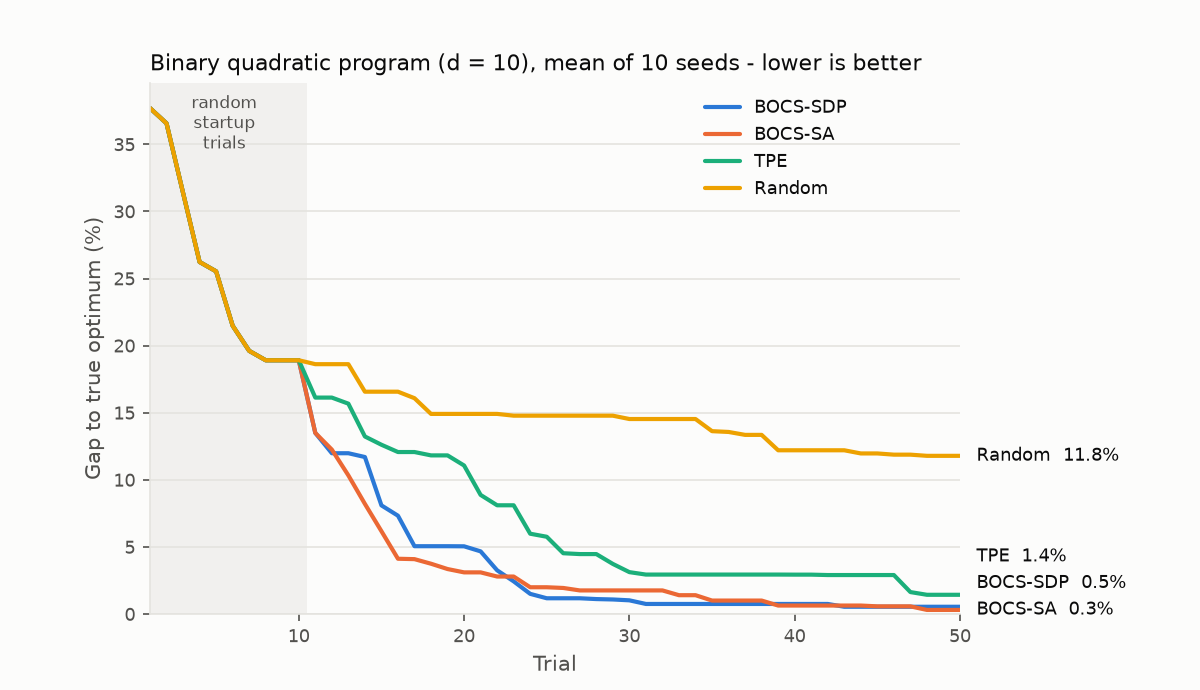
| Sampler | Gap after 25 trials | Gap after 50 trials | Optimum found (50 trials) | Time per trial |
|---|---|---|---|---|
| BOCS-SDP | 1.2% | 0.6% | 7 / 10 | 0.04 s |
| BOCS-SA | 2.0% | 0.3% | 9 / 10 | 0.03 s |
| TPE | 5.8% | 1.4% | 6 / 10 | 0.01 s |
| Random | 14.8% | 11.8% | 1 / 10 | < 0.01 s |
The gap is (f* - best value found) / (f* - f_min), averaged over 10 random instances with d = 10 binary variables (correlation length 10, as in Sect. 4.1 of the paper), where f* and f_min are found by enumerating all 1024 points.
BOCS has no constraint handling. Constrained problems have to be passed as a penalized objective, and because BOCS fits the objective’s values, unlike the rank-based TPE, the result depends strongly on the penalty weight. On the multidimensional_knapsack benchmark (20 items, 2 constraints, 10 instances, objective value - lambda * total violation), the gap to the optimum after 100 trials, among feasible points only and in percent, was:
lambda (multiple of total value / mean total weight) | BOCS-SDP | BOCS-SA | TPE | Random |
|---|---|---|---|---|
| 1 | 3.4 | 4.4 | 9.4 | 19.6 |
| 3 | 9.7 | 10.4 | 12.1 | 19.6 |
| 10 | 22.1 | 18.0 | 13.4 | 19.6 |
2 * max(value) / min(weight) | 22.8 | 19.9 | 14.2 | 19.6 |
TPE with constraints_func on the plain value reached 14.2%. So a penalty that is much larger than the objective’s scale makes BOCS no better than random search here. Prefer a penalty of the same scale as the objective, or TPE with constraints_func for problems where feasibility dominates.
Infinite objective values, for example inf returned at an infeasible point, are clipped to the range of the finite values observed so far before the model is fitted, as in GPSampler. Such a point is then modeled as no worse than the worst finite point, so a finite penalty on the objective’s scale is still preferable.
APIs
BOCSSampler(*, acquisition: Literal["sdp", "sa"] = "sdp", n_startup_trials: int = 10, penalty: float = 0.0, n_burnin: int = 1000, n_gibbs_steps: int = 100, n_rounding: int = 100, seed: int | None = None, independent_sampler: BaseSampler | None = None, warn_independent_sampling: bool = True)acquisition:"sdp"maximizes the sampled model with a semidefinite relaxation and randomized rounding;"sa"uses simulated annealing, which is cheaper when there are many binary parameters.n_startup_trials: Number of initial trials sampled byindependent_sampler.penalty: Weightlambdaof the regularizerlambda * sum(x)from the paper, in units of the standardized objective. A positive value favors points with fewer ones.n_burnin: Number of Gibbs sweeps before the first posterior sample.n_gibbs_steps: Number of Gibbs sweeps per trial afterwards. The Gibbs chain is warm-started from the previous trial.n_rounding: Number of randomized roundings per rounding method (only for"sdp").seed: Seed for the random number generator.independent_sampler: Sampler for the startup trials and for non-binary parameters. Defaults toRandomSamplerwith the same seed.warn_independent_sampling: Whether to warn when a non-binary parameter is sampled byindependent_samplerafter the startup trials.
Binary parameters are declared with trial.suggest_int(name, 0, 1) or with a two-choice trial.suggest_categorical(name, [a, b]). Other parameters are sampled by independent_sampler. Multi-objective optimization is not supported.
Installation
pip install -r https://hub.optuna.org/samplers/bocs/requirements.txt
BOCS-SDP solves the semidefinite program with CVXPY and its default open-source solver, Clarabel.
Example
import numpy as np
import optuna
import optunahub


rng = np.random.default_rng(0)
Q = rng.normal(size=(10, 10))


def objective(trial: optuna.Trial) -> float:
    x = np.array([trial.suggest_int(f"x{i}", 0, 1) for i in range(10)])
    return float(x @ Q @ x)


sampler = optunahub.load_module("samplers/bocs").BOCSSampler(seed=0)
study = optuna.create_study(direction="maximize", sampler=sampler)
study.optimize(objective, n_trials=50)
print(study.best_params, study.best_value)
Others
Implementation notes
- Coefficient sampling. The Gaussian full conditional of the coefficients is sampled with the algorithm of Bhattacharya et al. (2016), which solves an N-by-N system and is fast when there are fewer trials than coefficients. Once there are more trials than coefficients, a p-by-p Cholesky factorization is used instead. The Gibbs sampler is validated with a Geweke (2004) “getting it right” test.
- Rounding. The paper uses the randomized rounding of Charikar & Wirth (2004). This implementation applies both that rounding and random hyperplane rounding (Goemans & Williamson, 1995) and keeps the best point, which keeps the worst-case guarantee of the former. On random second-order models with d = 12, hyperplane rounding found the exact optimum of the acquisition on 97% of instances versus 43% for Charikar–Wirth alone.
- Simulated annealing. The paper refers to the schedule of Spears (1993) without constants. Here SA proposes
10 d^2single-bit flips and cools geometrically from the mean absolute single-flip change at the start point down to 1/1000 of it. - Objective scaling. Objective values are standardized before fitting, and the sign is flipped for minimization.
Reference
Ricardo Baptista and Matthias Poloczek. Bayesian Optimization of Combinatorial Structures. In Proceedings of the 35th International Conference on Machine Learning (ICML), 2018.
Bibtex
@inproceedings{baptista2018bocs,
  title={Bayesian Optimization of Combinatorial Structures},
  author={Baptista, Ricardo and Poloczek, Matthias},
  booktitle={Proceedings of the 35th International Conference on Machine Learning},
  pages={462--471},
  year={2018}
}
- Package
- samplers/bocs
- Author
- Anvesha Churi
- License
- MIT License
- Verified Optuna version
- 5.0.0
- Dependencies (.txt)
- cvxpy
- Last update
- 2026-11-05
- Discussions & Issues
- Create a discussion
- Create a bug report