Abstract
HierarchicalTPESampler is a mixture-of-experts variant of Optuna’s multivariate,
group-decomposed TPESampler for conditional search spaces (objectives where different
trials request different parameters, e.g. if optimizer == "adam": ...).
Why this exists. On a conditional (dynamic) search space, Optuna’s own multivariate
TPESampler is inadequate. With group=False the conditional parameters fall back to
independent (random) sampling, because a dynamic search space is not supported for
multivariate=True. With group=True the space is decomposed into parameter groups that are
each sampled independently, so correlation between groups is lost.
HierarchicalTPESampler keeps the group decomposition but samples the groups conditionally:
it decomposes the search space into Optuna parameter groups (sets of parameters that always
co-occur), infers a parent/child hierarchy between them, and gives each group its own Parzen
estimators (“experts”). For every expected-improvement candidate it samples the always-present
parameters first, then routes to the conditional children based on the values just sampled —
either with a learned DecisionTreeClassifier or with a user-supplied exact map. This lets it
capture correlation across conditional subspaces (e.g. between an always-present parameter
and a parameter that only appears in one branch), which independent group sampling cannot.
This is one of the two approaches proposed in optuna#5299. The other — the union-search-space approach — is explored in optuna#6697. See Difference from the union-search-space approach.
Class or Function Names
HierarchicalTPESampler
Arguments
HierarchicalTPESampler accepts the same arguments as
TPESampler
(such as n_startup_trials, n_ei_candidates, seed, constraints_func, constant_liar,
gamma, weights), plus:
conditional_fn(Callable[[dict[str, Any]], Iterable[str]] | None, defaultNone): an optional exact map of the conditional structure — see The conditional_fn exact map below for its exact input/output. IfNone, the structure is learned from observed trials with aDecisionTreeClassifier.
multivariate and group default to True because the hierarchical algorithm requires them. If
either is set to False, the sampler logs an INFO message and falls back to the standard
TPESampler behavior. With no conditional structure, the sampler is identical to
TPESampler(multivariate=True, group=True).
The hierarchy is always inferred automatically and is self-correcting: if a branch is mispredicted, the objective requests a parameter that was not sampled hierarchically, and that parameter is drawn by independent (univariate) TPE instead; the structure is re-inferred and the classifier refit on subsequent trials.
The conditional_fn exact map
conditional_fn lets you state the objective’s branching exactly instead of having it learned.
Its signature is Callable[[dict[str, Any]], Iterable[str]], and the sampler calls it once per
hierarchy level while building each candidate:
- Input — a dict of every parameter sampled so far on the current branch path, keyed by
name, with values in the external representation (exactly as in
trial.params: the chosen category, the float/int value). It holds the always-present parameters plus any conditional parameters already chosen higher up the path; it does not contain parameters that have not been sampled yet. - Output — an iterable of the names of the parameters the objective requests next given
that input (the parameters the very next
suggest_*call(s) would use). Return an empty list at a leaf (no further parameter). A conditional parameter group becomes active for the candidate when all of its parameter names are in the returned set; returning extra names is harmless.
Single-level example — x and t are always requested and y/z are conditional, so the
map mirrors the if x == "A":
def objective(trial):
    x = trial.suggest_categorical("x", ["A", "B"])
    t = trial.suggest_float("t", -2, 2)  # always requested
    if x == "A":
        return (trial.suggest_float("y", 1, 2) - t) ** 2
    return (trial.suggest_float("z", -2, 1) - t) ** 2


def conditional_fn(params: dict) -> list[str]:
    # e.g. params == {"x": "A", "t": 0.3}  ->  the objective requests "y" next
    return ["y"] if params["x"] == "A" else ["z"]
Multi-level example — when the branching is nested, conditional_fn is called once per
level with progressively more parameters, so branch on whichever gate is already present:
def objective(trial):
    x = trial.suggest_categorical("x", [True, False])
    y = trial.suggest_float("y", -1, 1)  # always requested
    if x:
        if trial.suggest_categorical("n", [True, False]):
            return (trial.suggest_float("a", -1, 1) - y) ** 2
        return (trial.suggest_float("b", -1, 1) - y) ** 2
    if trial.suggest_categorical("m", [True, False]):
        return (trial.suggest_float("c", -1, 1) - y) ** 2
    return (trial.suggest_float("d", -1, 1) - y) ** 2


def conditional_fn(params: dict) -> list[str]:
    # called as {"x": ..., "y": ...} -> next gate, then e.g. {"x": True, "y": ..., "n": ...} -> leaf
    if "n" in params:  # x was True; n decides a vs b
        return ["a"] if params["n"] else ["b"]
    if "m" in params:  # x was False; m decides c vs d
        return ["c"] if params["m"] else ["d"]
    return ["n"] if params["x"] else ["m"]  # top level: x decides n vs m
Installation
$ pip install optuna scikit-learn

# or, equivalently:
$ pip install -r https://hub.optuna.org/samplers/hierarchical_tpe/requirements.txt
Example
from __future__ import annotations

import optuna
import optunahub


# A conditional search space: `x` gates whether `y` or `z` is requested, and the always-present
# `t` is coupled to whichever is active.
def objective(trial: optuna.Trial) -> float:
    x = trial.suggest_categorical("x", ["A", "B"])
    t = trial.suggest_float("t", -2, 2)
    if x == "A":
        y = trial.suggest_float("y", 1, 2)
        return (y - t) ** 2
    z = trial.suggest_float("z", -2, 1)
    return (z - t) ** 2


HierarchicalTPESampler = optunahub.load_module(
    package="samplers/hierarchical_tpe"
).HierarchicalTPESampler

sampler = HierarchicalTPESampler(seed=0)
study = optuna.create_study(sampler=sampler)
study.optimize(objective, n_trials=50)
print(study.best_params, study.best_value)
To state the branching exactly instead of having it learned, pass conditional_fn — see
The conditional_fn exact map.
Difference from the union-search-space approach
optuna#5299 proposed two ways for multivariate TPE to handle correlated conditional subspaces:
- Union search space (optuna#6697,
group=False): pad inactive parameters withNaNand estimate a single joint distribution over the union of all parameters. - Hierarchical / mixture-of-experts (this package,
group=True): keep a separate expert per parameter group and route between them with an inferred hierarchy plus a classifier or exact map.
The union model estimates one joint distribution over the NaN-padded union of all parameters. The hierarchical model instead scores each parameter group by its conditional ratio given its always-present ancestors, which captures the correlation between an always-present parameter and a conditional one. Because it predicts which branch is active, a mispredicted branch falls back to independent sampling for the affected parameter.
Benchmark
The benchmark below reproduces the comparison from
optuna#5299 on a conditional objective with an
always-present parameter y coupled to whichever conditional leaf is active (so cross-subspace
correlation matters), over 128 repetitions with each sampler at its best n_ei_candidates. The
standard samplers converge quickly but plateau, while both HierarchicalTPESampler variants keep
improving — and reach the lowest loss — by exploiting the y-to-leaf correlation through the
conditional acquisition. Reproduce it with python package/samplers/hierarchical_tpe/benchmark.py.
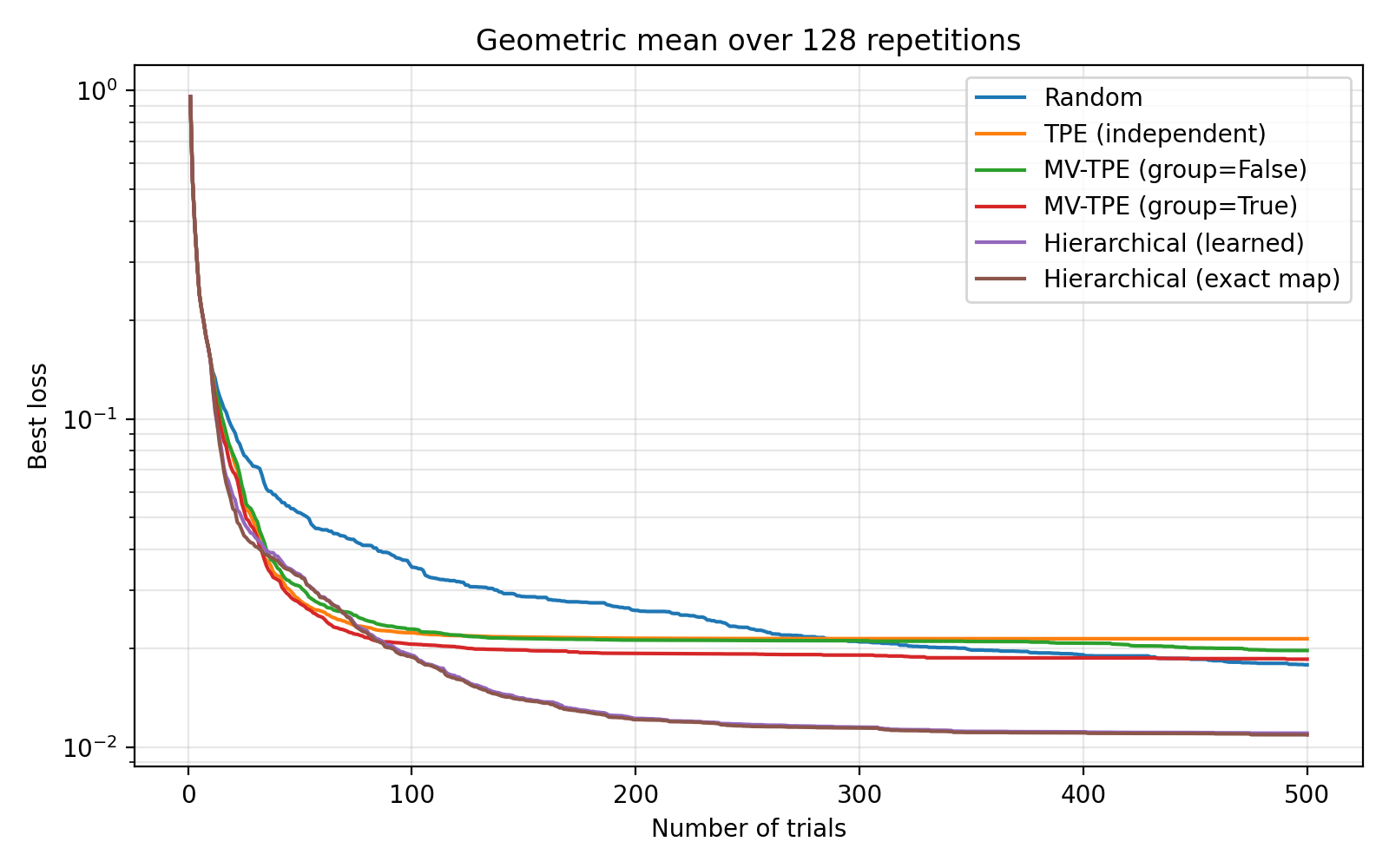
The MV-TPE (group=False) curve uses standard independent fallback on released Optuna; run the
benchmark against the optuna#6697 branch to obtain
the union-search-space curve instead.
Reference
Proposed in optuna#5299. The sibling union-search-space approach is optuna#6697.
Test
$ pip install pytest
$ pytest package/samplers/hierarchical_tpe/tests/
- Package
- samplers/hierarchical_tpe
- Author
- Lars Andersen Bratholm
- License
- MIT License
- Verified Optuna version
- 4.8.0
- Dependencies (.txt)
- optuna>=4.0.0
- scikit-learn
- Last update
- 2026-06-11
- Discussions & Issues
- Create a discussion
- Create a bug report