Abstract
optuna.samplers.BruteForceSampler explores a define-by-run search space as a tree: each
internal node is a parameter, and a path from the root to a leaf is one trial’s complete
params. This package renders that tree as an interactive
icicle chart, so you can see which branches have
been sampled, how each trial’s parameters relate to one another, and how much of a finite
(grid-like) search space is still unexplored.
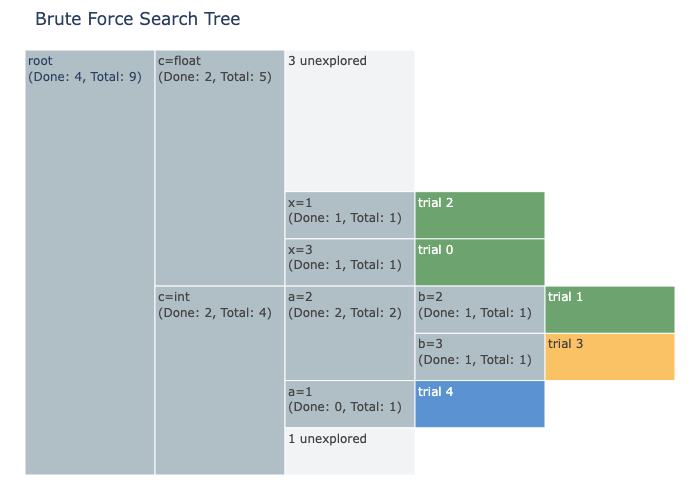
Leaves are colored by trial state (complete/pruned/failed/running); hovering over a complete
trial’s leaf shows its objective value(s). A synthetic ... unexplored leaf is added under every
branching point that still has unvisited candidate values.
APIs
plot_brute_force_tree(study)
study(optuna.Study): A study, ideally optimized withBruteForceSampler. Any study works, but the “unexplored” counts are only meaningful for finite, grid-like search spaces (e.g.IntDistributionorFloatDistributionwithstepset, orCategoricalDistribution).
Returns a plotly.graph_objects.Figure.
Example
import optuna
import optunahub


module = optunahub.load_module("visualization/plot_brute_force_tree")


def objective(trial: optuna.Trial) -> float:
    c = trial.suggest_categorical("c", ["float", "int"])
    if c == "float":
        return trial.suggest_float("x", 1, 3, step=0.5)
    else:
        a = trial.suggest_int("a", 1, 3)
        b = trial.suggest_int("b", a, 3)
        return a + b


study = optuna.create_study(sampler=optuna.samplers.BruteForceSampler(seed=42))
study.optimize(objective, n_trials=30)

fig = module.plot_brute_force_tree(study)
fig.show()
Others
This package only reads public optuna.trial.FrozenTrial fields (params, distributions,
state, values), so it does not depend on BruteForceSampler’s private tree implementation
and works across Optuna versions.
- Package
- visualization/plot_brute_force_tree
- Author
- Shuhei Watanabe
- License
- MIT License
- Verified Optuna version
- 4.9.0
- Dependencies (.txt)
- optuna
- plotly
- Last update
- 2026-07-08
- Discussions & Issues
- Create a discussion
- Create a bug report